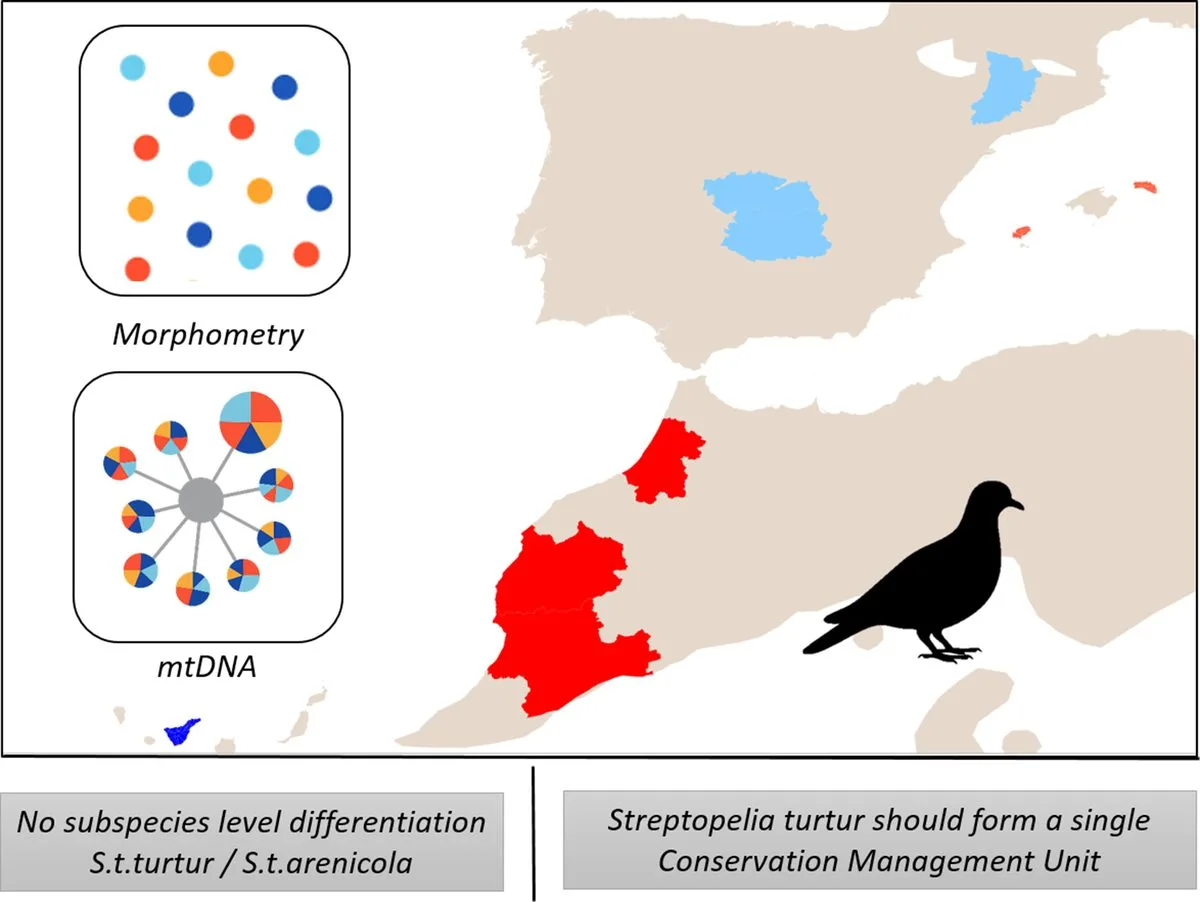
New study suggests no subspecies-level differentiation between Turtle Dove populations on either sides of the Strait of Gibraltar. It concluded that the species should be treated as a single conservation management unit.
The European Turtle Dove (Streptopelia turtur) is a migratory bird species with a deep cultural heritage across the Mediterranean region and beyond. However, following a generalised population decline across much of its range, especially the 83% decline in the Western European population since 1980, understanding and conserving this species is more urgent than ever. Although the population along the Western European flyway has begun to rebound following a four-season hunting moratorium in Europe, this recovery remains fragile. The reopening of hunting in 2025, coupled with other underlying threats, could compromise the recovery before the population has fully returned at least to the levels recorded in the 1990s.
Taxonomy and distribution
Traditionally, four distinct subspecies have been recognised based on differences in size and plumage. Among these, the nominate subspecies, S. t. turtur, breeds across Europe and is characterised by darker wings and bold black-and-white neck stripes. The North African subspecies, S. t. arenicola, is generally described as a paler, sandier, and traditionally considered to be smaller. The other two subspecies, S. t. hoggara and S. t. rufescens, are largely sedentary desert populations. S. t. hoggara occurs in the central Sahara, particularly in southern Algeria, while S. t. rufescens is breeding in the oases of southeastern Libya and Egypt and along the Nile Valley.
New morphometric and genetic study
A recent study by Julio Domínguez and his colleagues (2026) has challenged this traditional subspecies split in the western Mediterranean region. The study combined biometric measurements (wing, tail, and leg lengths) with an analysis of maternal mitochondrial DNA (mtDNA). To address a limitation of a previous study, they focused exclusively on breeding birds captured during the breeding season in Spain and Morocco.
The results revealed that the Spanish and Moroccan breeding populations are not distinct, either morphologically or genetically. Biometric analysis showed there is an overlap in the measured traits between the two populations, while their mtDNA is indistinguishable (In other words, there was no geographical structuring in their mtDNA, as would be expected from the distribution of the two subspecies). This lack of differentiation is likely due to continuous gene flow between the populations. These findings suggest that western Mediterranean Turtle Doves belong to a single, connected biological unit, pointing to a need for a coordinated, transboundary hunting and conservation regulations between Western Europe and Morocco.
However, there are some limitations acknowledged by the authors that should be taken into consideration. The study did not analyse plumage colouration, historically the main criterion for distinguishing the paler arenicola subspecies. Furthermore, because the study used only mtDNA (inhereted maternally), comprehensive nuclear genomic research is still required to fully confirm if these populations are completely identical.
For now, the main challenge is how to translate the main finding of the study, that the populations on both sides of the Strait of Gibraltar constitute a single biological unit, into conservation action by managing them as a single “conservation unit”. Understanding the current status and trend of the Moroccan population is also very crucial for effective conservation efforts. An unpublished study suggests that it is the third or second-largest population overall, potentially just behind the Spanish population.
Reference:
Domínguez JC, Bota G, García JT, Arroyo B, Hanane S, Escandell R, Sardà-Palomera F, Ichen A, Moreno-Zarate L (2026). No subspecies, no borders: morphometric and mitochondrial DNA evidence in western Mediterranean European Turtle-doves. Bird Conservation International, 36, e25, 1–12 https://doi.org/10.1017/S0959270926100525