The Mogador Islands, off Morocco’s Atlantic coast, are home to the world’s largest breeding colony of Eleonora’s Falcon. But could opening this natural treasure to visitors in the name of ecotourism development put it at risk?
Read the perspective of Prof. Aziz Benhoussa on why this issue deserves very careful consideration.
Opening Mogador Island to the public, Yes… But at what cost to Eleonora’s Falcon?
Mogador Island, off the coast of Essaouira, may soon be the subject of a development project designed to accommodate more visitors. According to the available information, the project includes the creation of an approximately 2.1-kilometre discovery trail, along with various facilities intended to showcase the island’s historical and natural heritage.
In principle, making such exceptional heritage accessible to the public is a legitimate undertaking. However, this ambition raises a fundamental question: Can Mogador be opened to regular public visits without compromising the breeding conditions of its wildlife? The answer cannot be based solely on tourism considerations. It must rest on sound scientific evidence and a rigorous assessment of ecological risks.
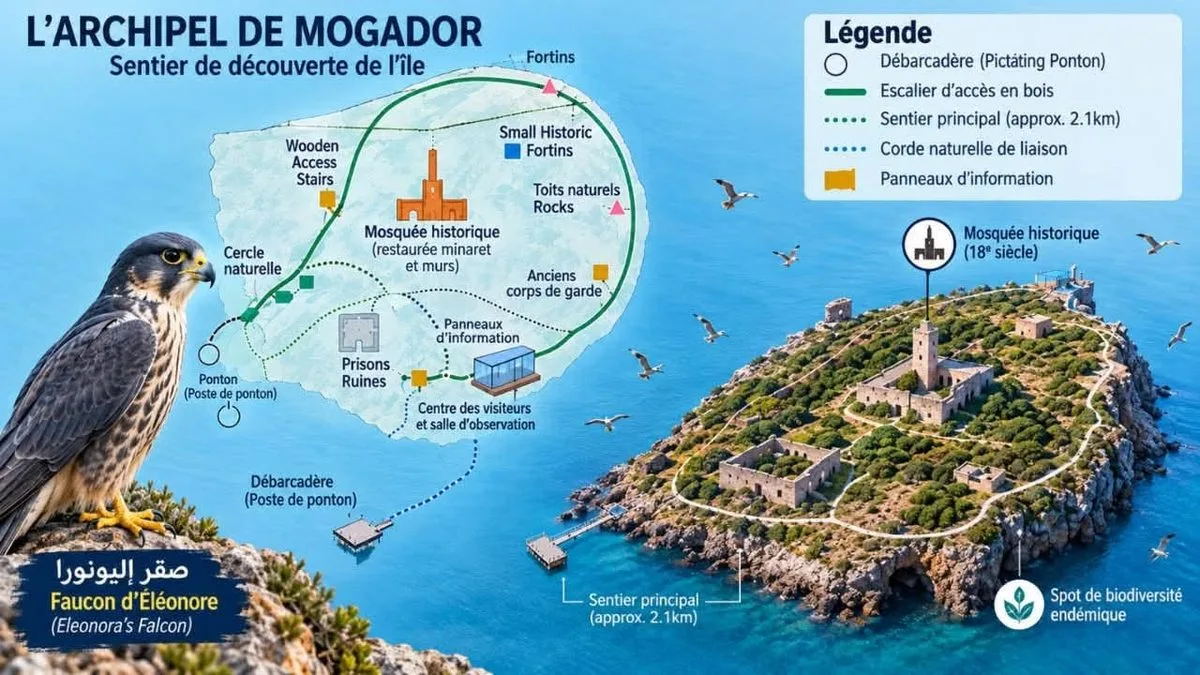
An exceptional sanctuary for Eleonora’s Falcon
The Essaouira archipelago is a site of major importance for Eleonora’s Falcon (Falco eleonorae), an emblematic species of Mediterranean and Atlantic islands and cliffs. Its presence gives Mogador an ecological and scientific value that extends far beyond its tourism potential.
Data from our scientific monitoring reveal a remarkable change in the breeding population: 677 nests recorded in 2010 compared with 1,875 in 2026, an increase of nearly 177% over sixteen years. The recorded number of nests is therefore approximately 2.8 times higher than at the beginning of the monitoring programme.
These figures are more than mere statistics. They demonstrate the biological importance of the site and underscore the need to preserve the conditions that have accompanied the growth of this population. Any change in the level of human activity must therefore be examined with the utmost care.
Tourism development is not without risks
Regularly opening an island that has so far experienced relatively little visitor activity would bring about a significant change to its environment. The creation of a marked trail could certainly help limit uncontrolled visitor movements, but it would not, on its own, eliminate the risk of disturbance.
Noise, proximity to nesting areas, groups of visitors, repeated embarkation and disembarkation operations, and other tourism-related activities could affect bird behaviour, particularly during the breeding season.
In colonial-nesting species, repeated disturbance can reduce the time devoted to incubation and feeding, alter breeding behaviour and, in the most critical situations, lead to the abandonment of some nesting sites.
It would therefore be unwise to assume that a designated trail automatically guarantees protection. Human presence must be organised around the needs of the ecosystem, not the other way around.
Assess ecological carrying capacity before determining visitor numbers
The issue is not to set tourism against nature conservation, but to determine the conditions under which these two objectives can coexist without jeopardising biodiversity.
Before the island is opened to regular public visits, a thorough scientific assessment should precisely identify the colonies and nesting areas, the periods of greatest sensitivity, and the minimum distances to be maintained around breeding sites.
The assessment should also measure the potential effects of noise and visitor activity, examine embarkation and disembarkation arrangements, determine the acceptable frequency of visits, and take weather-related and seasonal constraints into account. Finally, it should establish monitoring mechanisms that would allow protective measures to be adjusted promptly in response to observed results.
In other words, Mogador’s ecological carrying capacity must be determined before its tourism capacity. Visitor numbers cannot be set independently of the site’s biological limits.
Seven measures for a science-based opening
Given the exceptional value of the archipelago, we consider the following safeguards essential:
- Subject the project to a thorough environmental and scientific assessment, taking into account the direct and indirect effects of tourism on habitats and species.
- Make the scientific studies and expert assessments used to develop the project publicly available, ensuring transparent decision-making and allowing specialists to scrutinise them.
- Scientifically determine the island’s ecological carrying capacity before making any decisions regarding visitor numbers or the frequency of excursions.
- Establish a permanent scientific committee, including ornithologists, ecologists and biodiversity specialists, to support the project and assess its consequences.
- Implement a monitoring protocol before, during and after the opening, enabling the effects of visitor activity on Eleonora’s Falcon and other species present on the island to be objectively measured.
- Introduce seasonal and spatial restrictions, particularly during the most sensitive breeding periods, with the possibility of temporarily closing certain areas.
- Postpone regular public access if sufficient scientific safeguards are not in place, until the conditions necessary to conserve the site have been met.
These measures are not intended to prevent all tourism development. Rather, they seek to ensure that a project designed to introduce Mogador to the public does not ultimately undermine what constitutes an essential part of its natural wealth.
Mogador: Far more than a tourist destination
Reducing Mogador to its architectural heritage or tourism potential would mean overlooking a fundamental dimension of its identity. The island is also a refuge for biodiversity, a site for scientific research, and a living natural heritage whose value cannot be measured by the number of visitors it receives.
Its historical legacy and ecological richness should not be set against one another. They are complementary dimensions of the same heritage, both deserving equal attention and protection.
Showcasing Mogador, therefore, does not simply mean making it easier to access. It means designing a visitor experience that respects the site and is compatible with the conservation requirements of its habitats and species.
Protecting today to pass it on to future generations
Sustainable development does not mean carrying out development first and then looking for ways to repair any damage that may occur. It requires anticipating impacts, drawing on available scientific knowledge, and applying the precautionary principle when risks warrant it.
The Essaouira archipelago currently shows particularly encouraging trends, with its breeding population of Eleonora’s Falcon increasing from 677 to 1,875 nests over sixteen years of monitoring. This represents a valuable ecological achievement that must not be jeopardised by an inadequately planned opening to visitors.
Our collective responsibility is to preserve this balance. Mogador deserves to be discovered, but above all, it deserves to be respected and protected.
Future generations must inherit the island not only with its ramparts, history and memory, but also with its birds, natural habitats and the exceptional biological richness that makes the Essaouira archipelago an irreplaceable living heritage.